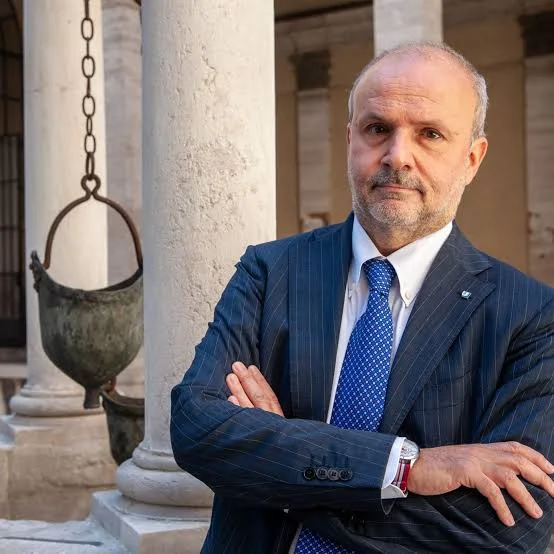
A Roman physician who became a professor of nuclear medicine, the head of a medical faculty, the Rector of a major public university and, in 2022, Italy's Minister of Health.
Born
27 April 1966, Rome
Education
Sapienza University of Rome
Specialism
Nuclear medicine
Current office
Minister of Health
Chapter I
Origins and education
Orazio Schillaci was born in Rome on 27 April 1966. Italian press profiles published at the time of his appointment describe a family of Calabrian origin. Little else about his early life is on the public record, and this biography does not go beyond what has been documented.
He studied Medicine and Surgery at Sapienza University of Rome, Italy's largest university and one of its oldest medical schools, and graduated in 1990. He then completed postgraduate training in nuclear medicine at Sapienza, obtaining the specialist diploma in 1994. Italian medical specialisation is a formal, multi-year residency, and nuclear medicine is one of its most technical branches, combining clinical medicine, radiation physics, radiopharmacy and image interpretation.
In 2000 he completed a research doctorate (dottorato di ricerca) at Sapienza in radioisotopic functional imaging, the use of radioactive tracers to show how organs function rather than only what they look like. In 2009 he added a second specialisation, in radiodiagnostics, at the University of Rome Tor Vergata. Holding both qualifications reflected the convergence of the two disciplines in hybrid imaging systems such as PET/CT and SPECT/CT.
Chapter II
The specialist
Before joining Tor Vergata, Schillaci worked as a university researcher at the University of L'Aquila. In 2001 he moved to the University of Rome Tor Vergata as associate professor of nuclear medicine. Italian sources also record him from that year as head of the nuclear medicine service at the Policlinico Tor Vergata, the university hospital in the south-east of Rome.
His clinical and scientific interests, as summarised in institutional profiles, were nuclear medicine, molecular imaging and image fusion: combining functional images from PET or SPECT with anatomical images from CT or MRI so that a tracer's signal can be placed precisely in the body. These techniques are central to modern oncology, from staging a tumour to judging whether a treatment is working.
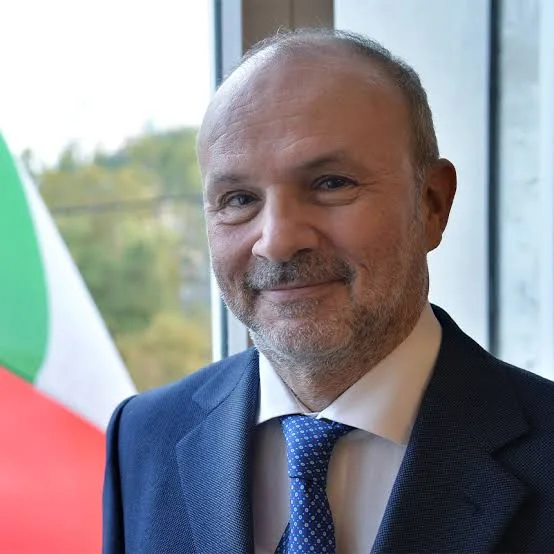
Orazio Schillaci beside the Italian tricolour.
Profiles prepared for international meetings, including the OECD Health Ministerial, credit him with more than 350 peer-reviewed publications and membership of the editorial boards of scientific journals. See Research & Science.
Chapter III
The academic
Schillaci became full professor of nuclear medicine at Tor Vergata in 2007. In 2008 he took over as director of the university's school of specialisation in nuclear medicine, responsible for training resident physicians in the discipline. Between 2006 and 2009 he also served as an expert member of the Consiglio Superiore di Sanità, the Higher Health Council that advises the Minister of Health on technical and scientific matters.
From 2011 he took on faculty leadership, first as vice-president and then as president (dean) of the Faculty of Medicine and Surgery. The role combined academic planning with the governance of a teaching hospital: degree programmes, specialist schools and the clinical services where students and residents train. Italian sources also record his appointment in 2018 as director of the onco-haematology department at Policlinico Tor Vergata.
In 2020, Health Minister Roberto Speranza appointed him to the scientific committee of the Istituto Superiore di Sanità (ISS), Italy's national public health institute, during the COVID-19 emergency.
Chapter IV
The Rector
On 1 November 2019 Schillaci became Rector of the University of Rome Tor Vergata, founded in 1982 and today one of the three large state universities in the capital. His term was dominated by the pandemic, when universities moved teaching online, faculties of medicine supported the health system and the university hospital took on a large share of the clinical response.
He remained Rector until he entered government in October 2022. When he was appointed, the university published a note recording that his nomination brought "further prestige and recognition" to Tor Vergata.
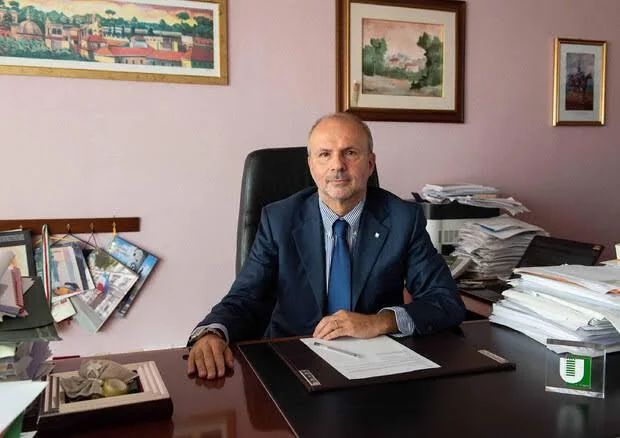
At his desk, in an office hung with framed paintings.Chapter V
Into government
Following the general election of September 2022, Giorgia Meloni formed a new government. The list of ministers was announced on 21 October 2022 and Schillaci, who was not a member of any party, was named Minister of Health. He was sworn in on 22 October 2022 at the Quirinale Palace. It was his first political role.
He described the appointment as "a great honour" and an opportunity to serve the Nation, saying he hoped his experience as a doctor and academic would help provide concrete answers for the protection of public health. He succeeded Roberto Speranza, who had led the ministry through the pandemic.
Chapter VI
The ministry
As minister he has dealt with waiting times, health workforce shortages, delivery of the PNRR's health investments, mental health and pandemic preparedness. Among the main national measures of his mandate are Decree-Law 73 of 7 June 2024 on waiting lists, the National Action Plan for Mental Health 2025–2030, the Pandemic Plan 2025–2029 approved in April 2026 and the 2026 update of the essential levels of care.
Internationally, he chaired the G7 Health Ministers' Meeting in Ancona in October 2024 during Italy's G7 presidency and represented Italy at the United Nations, the OECD and the World Health Organization. His ministerial work is described in full on the Minister of Health page.
Chapter VII
Timeline
27 Apr 1966
Born in Rome
Born in the Italian capital.
1990
Degree in Medicine and Surgery
Sapienza University of Rome.
1994
Specialisation in nuclear medicine
Sapienza University of Rome.
2000
Doctorate in radioisotopic functional imaging
Sapienza University of Rome.
Until 2001
University researcher
University of L'Aquila.
2001
Associate professor of nuclear medicine
University of Rome Tor Vergata.
2006–2009
Higher Health Council
Expert member of the Consiglio Superiore di Sanità.
2007
Full professor
Full professor of nuclear medicine at Tor Vergata.
2008
Director of the specialisation school
School of specialisation in nuclear medicine, Tor Vergata.
2009
Specialisation in radiodiagnostics
University of Rome Tor Vergata.
2011–2019
Faculty leadership
Vice-president, then president, of the Faculty of Medicine and Surgery, Tor Vergata.
1 Nov 2019
Rector of Tor Vergata
Rector until 22 October 2022.
2020
Istituto Superiore di Sanità
Appointed to the ISS scientific committee.
22 Oct 2022
Minister of Health
Sworn in as Minister of Health in the Meloni Government (current office).
9–11 Oct 2024
G7 Health, Ancona
Chairs the G7 Health Ministers' Meeting under the Italian presidency.
Sources: Italian and English Wikipedia entries and their cited press sources (Adnkronos, Sky TG24); University of Rome Tor Vergata; OECD; Quotidiano Sanità. Entries are listed in the order the roles began.